
The 8D Report Guide: Stop Firefighting and Pointless Paperwork
When a customer reports an issue and the production line stops, panic often sets in. Many people treat the 8D report merely as a necessary evil—a spreadsheet you quickly fill out just to get the customer off your back. In reality, it is a critical emergency brake and a highly essential problem-solving framework.
The 8D methodology keeps the entire cross-functional team aligned. It provides clear direction on next steps and, most importantly, ensures you don't lose focus on the actual problem.
Let’s bust a massive myth right from the start: The 8D report is not a one-man job. A Quality Engineer sitting alone at a desk will never find the true root cause. You need a team and real shop-floor insights.
How the 8D Process Works Step by Step (D1–D8)
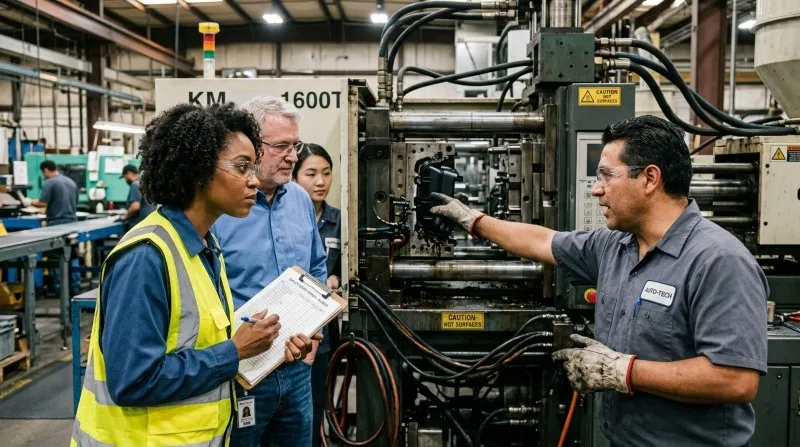
- D1: Team Formation: The Quality Engineer is there to facilitate the process, not to invent all the answers. Bring in an operator, shift leader, process engineer, or setter—the people who truly understand the manufacturing process.
- D2: Problem Description: Forget vague statements like "the part is NOK." What exactly happened, where, on which station, and what are the symptoms? Use the 5W2H method to define the problem accurately.
- D3: Interim Containment Actions (ICA): Stop the bleeding. Implement 100% sorting in the warehouse and inform logistics. You must immediately ensure that not a single additional defective part escapes to the customer, while keeping them updated on the containment status.
- D4: Root Cause Analysis (RCA): This is the moment of truth. Why did the problem occur in the first place, and why didn't our system detect it? The team cannot settle for the first obvious answer. This is where the Ishikawa (Fishbone) diagram and the 5 Whys method come in to pinpoint the true root cause.
- D5: Permanent Corrective Actions (PCA) Selection: How do we practically and permanently eliminate the defect? The team selects the best possible solutions that directly eliminate the root cause identified in D4.
- D6: Implementation and Validation of PCA: We deploy the actions directly on the shop floor and closely monitor the data. Is it really working? Has the defect permanently disappeared?
- D7: Preventive and System Actions: Be careful, this is a common trap. Preventive and system-level actions do not belong in D5 or D6—they strictly belong here! This is where you update the FMEA, Control Plans, and standard procedures to ensure the same failure never occurs on any other project.
- D8: Closure and Team Recognition: Done. The customer is satisfied, and the problem is resolved. Thank the people who investigated the issue at the line with you, and officially close the report.
What's Next?
The 8D report is more than just a piece of paper; it’s a reflection of how well your company solves problems. In our next article, we will dive deeper into practical tips—exactly what to write in each step, what pitfalls to avoid, and what auditors actually want to see.