
⏱ Reading Time: 2 minutes
5 Whys Method: Why "Human Error" Doesn't Belong in an 8D Report
You know the drill. A customer claim lands on your desk, the deadline for submitting the 8D report is approaching, and in the D4 section (Root Cause Analysis) it boldly states: "Operator error." This is immediately followed by the standard corrective action: "Retraining." The customer might accept it the first time amidst the pile of paperwork, but let’s be honest with ourselves – in a month, you'll have the exact same defect back.
Whether a mistake is made by an operator on the line, a setter during a machine changeover, or a team leader during inspection, one thing is certain: If your 5 Whys analysis ends with human error, you haven't solved anything. So, how do you handle it correctly?
Rule 1: Attack the Process, Not the People
No one goes to the morning shift aiming to intentionally produce scrap. If an employee makes a mistake, it simply means your process allowed them to do so. Stop looking for a culprit; look for the systemic loophole.
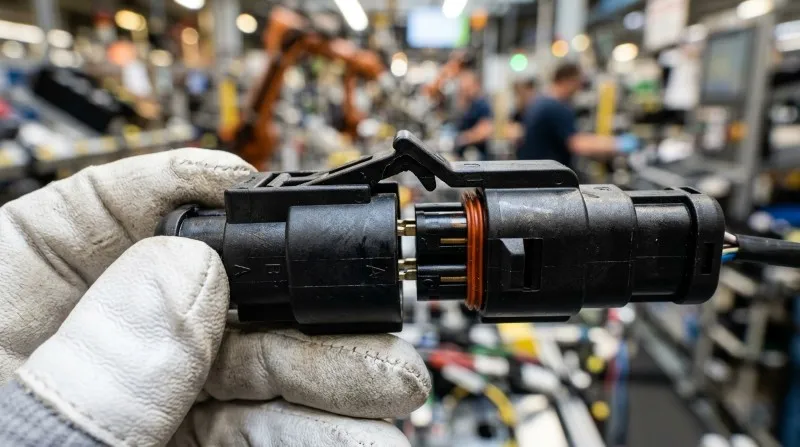
- Real-world example (Unclicked connector): Why wasn't the connector fully engaged? Because the setter incorrectly adjusted the stop on the press. Why was it adjusted incorrectly? Because the calibration master part was missing at the workstation. The real corrective action here isn't a "warning letter for the setter," but changing the system for storing and checking calibration standards.
Rule 2: You Can't Solve It from Your Desk (Go to Gemba)
The worst root cause analyses are created in an air-conditioned meeting room with a projector. If you're guessing causes over an Excel spreadsheet without holding the defective part in your hand, you're just making things up. Go directly to the shop floor (Gemba) and talk to the people who are there every day.
- Real-world example (Scratched visual plastic part): From your desk, you deduce "careless handling." But when you go down to the line, the team leader shows you that the new KLT boxes from logistics are a centimeter narrower inside than needed, causing the parts to scrape against each other during loading. The meeting room would never have figured this out.
Rule 3: The Reverse Reading Test (How to fill the form correctly)
This is a brilliant and lightning-fast test of your analysis's logic. Read your 5 answers from the bottom up and connect them with the word "because". The chain must make 100% logical sense.
- The part had an unclicked connector because the press didn't reach its final position.
- The press didn't reach its final position because the stop was shifted by 2 mm.
- The stop was shifted because the setter used the wrong gauge.
If your logical chain stumbles anywhere, you've skipped a step and there's a hole in your analysis.
Rule 4: Does it always have to be exactly 5 times?
No. Sometimes you get to the core of the problem by the third "Why," and sometimes you need seven. The goal isn't to slavishly fill out five boxes on a form. The goal is to reach a point where you discover a systemic error whose fix (e.g., implementing a Poka-Yoke sensor) is within your power and will physically prevent the problem from reoccurring.
Don't Let Excel Slow You Down
In practice, it often happens that the team at the line finally uncovers the true root cause, but the quality engineer then spends an hour fighting with the formatting of a broken Excel sheet just to make the report look professional.
That is exactly why the interactive guide on getqualitytools.com exists. You enter your data directly at the line from a tablet or in the office, the app ensures logical structure, and with one click, it generates a clean, professional PDF ready for your OEM customer.