In the automotive industry, processes are generally expected to achieve a Cpk of 1.33 or ideally 1.67. But what do these abstract statistical figures actually mean for a Quality Engineer and a manager? Let's translate them into reality – through the number of defective parts or Parts Per Million (PPM).
Why is Cpk 1.0 Not Enough?
A value of Cpk = 1.0 for a perfectly centered process means that the edges of the Gaussian curve (normal distribution) exactly touch the tolerance limits (LSL and USL). In a theoretical mathematical model, this generates 2,700 defective parts per 1 million produced parts (PPM). In practice, however, machines slightly "drift" – tooling wears out, shop floor temperatures fluctuate. Therefore, the actual number of defective parts is much higher.
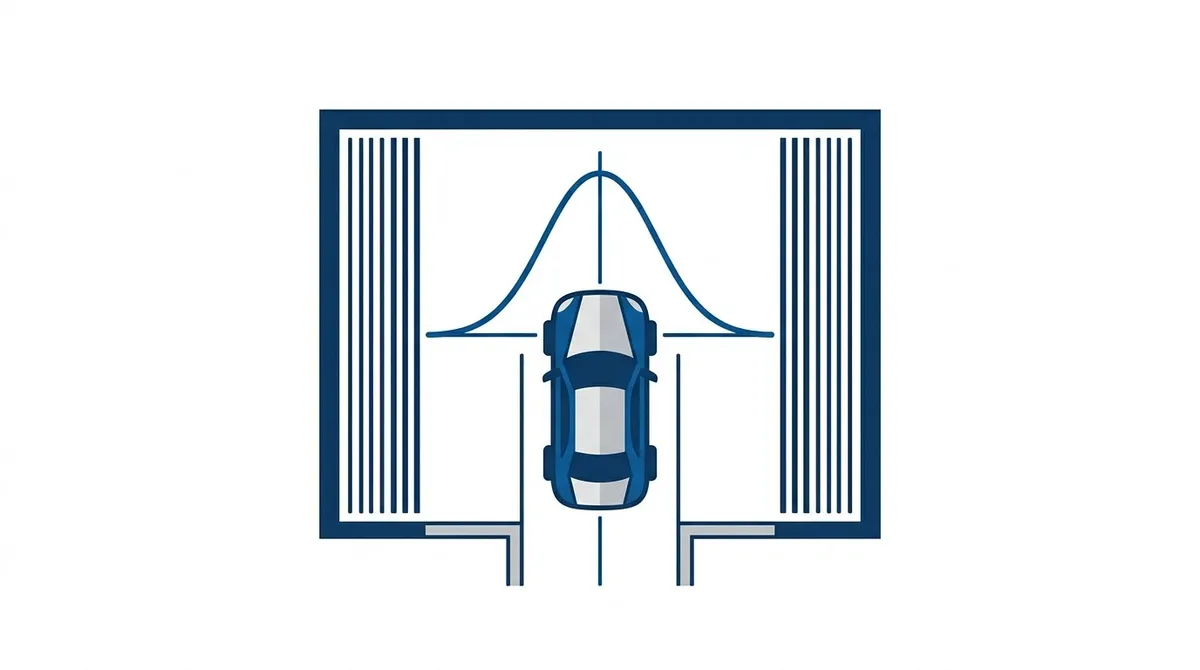
The Difference Between Cp and Cpk (The Garage Door Metaphor)
Imagine the tolerance as a garage door and your process as a car. Cp (Potential Capability) tells you if your car is narrow enough to fit through at all. Cpk (Actual Centering) tells you whether you are aiming for the center and won't scrape your mirror on the door frame. To avoid producing scrap, you need both – a narrow spread (low variation) and good centering.
Try It Yourself (Interactive Calculator)
The actual number of defects depends on both the total width of your process (Cp) and its shift off-center (Cpk). Try adjusting both sliders to see in real-time how the number of defective parts (PPM) skyrockets.
The Golden Standard: 1.33 and 1.67
- Partially Capable (Cpk 1.00 to 1.32): The process is running, but you are living on the edge. Any minor machine fluctuation will send you into the red zone. At this level, you usually cannot avoid 100% part inspection.
- Capable (Cpk = 1.33): For a centered process, this means a theoretical 63 PPM (31 on each side). This is the absolute minimum for the process to survive normal material and shift variations. At this value, you can typically eliminate expensive 100% inspection and switch to sampling (random inspection).
- Excellent Capability (Cpk = 1.67): Generates approximately 0.6 PPM. Here we are talking about a world-class process. The automotive industry requires this value for Critical Characteristics (CC) and Significant Characteristics (SC). It acts as a safety cushion in case the machine shifts over time (the well-known 1.5 sigma drift), ensuring that no life-threatening parts ever reach the customer.
Use our free Process Capability Calculator, enter your measured production data, and generate a professional histogram with a single click.